
Shadow AI - Risks, Realities and Responsible Use
29/10/2026
Authored By:


What is Shadow AI?
Artificial intelligence is rapidly changing how organizations work, creating opportunities to improve productivity, automate tasks and support decision-making. However, as employees increasingly turn to AI tools to get their work done, organizations face a growing challenge: how to encourage innovation while protecting sensitive information, maintaining compliance and managing risk. Understanding Shadow AI is an important first step toward achieving that balance.
While these tools can provide significant productivity benefits, their unauthorized use can introduce data security, privacy, regulatory, intellectual property, and compliance risks. Organizations are increasingly adopting GenAI faster than they can establish appropriate governance, creating a growing gap between approved AI use and employee-driven adoption. Without clear policies, technical controls, and awareness, organizations may have limited visibility into where AI is being used, what information is being shared, and whether its use aligns with organizational and regulatory requirements.
Where Shadow AI Enters
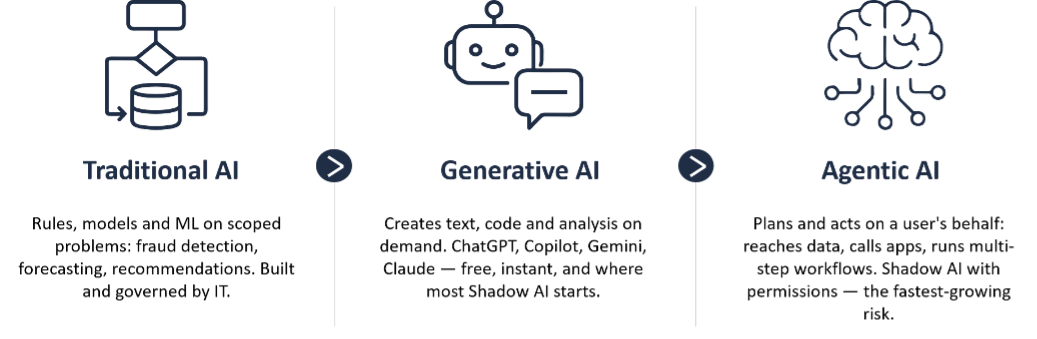
The risks become more complex as AI evolves from traditional systems designed for specific tasks, to generative AI that creates content and code, and agentic AI that can access systems, invoke applications and execute multistep workflows. Each progression can introduce new levels of access, autonomy and potential organizational exposure.
Shadow AI Examples and Usage by the Numbers
Shadow AI presents an organization-wide challenge that extends well beyond IT. Employees may submit sensitive information to public chatbots, adopt unapproved productivity tools, install unauthorized coding extensions, or activate AI features within existing software without IT awareness.
AI is becoming an increasingly accessible layer of workplace productivity, often spreading faster than organizations can establish appropriate governance. Employees can now use AI to generate content, analyze information, write code and automate activities with minimal barriers to entry.
The information involved can include source code, research and development material, sales and marketing information, internal communications, employee records, legal documents, financial information and customer data.
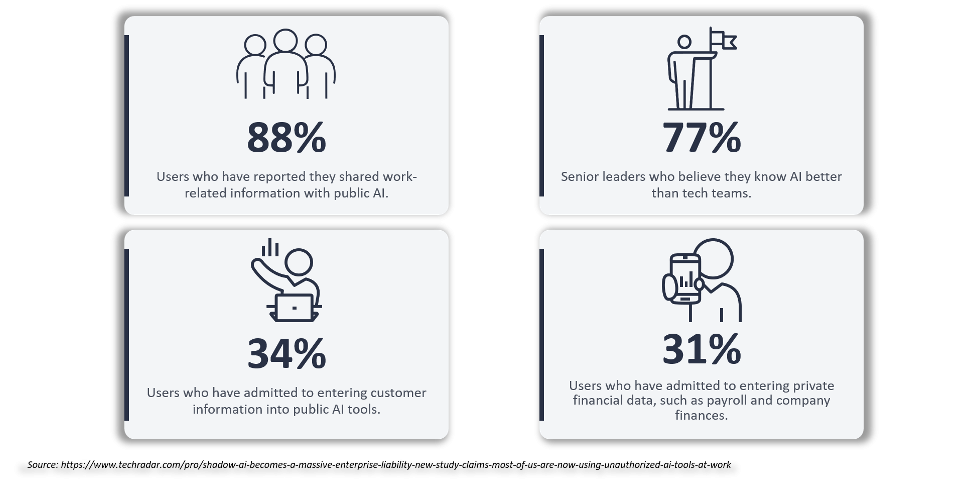
The figures should be interpreted in the context of their underlying survey methodology, but the broader concern remains: employees may be sharing sensitive business information without fully understanding the consequences.
Organizational Risks Associated with Shadow AI
Security, privacy, and ethics are deeply intertwined in AI adoption, and without focused attention and mitigation measures, Shadow AI can create significant risk across organizations.
Security Risks
Shadow AI can create a pathway for sensitive information to leave an organization’s controlled environment. For example, an employee may sign in to a personal AI account, submit internal documents or confidential information, and receive a generated response without understanding how the provider handles the submitted data.
Information entered into AI systems may raise concerns about retention, access and potential disclosure. Even a routine request, such as asking an AI tool to troubleshoot a registration system using database schemas and sample records, can expose sensitive information.
Similarly, AI tools connected to files, applications and conversations may create additional risks if granted broad permissions. Organizations must therefore assess not only the prompts employees submit, but also the data sources and system access available to AI tools.
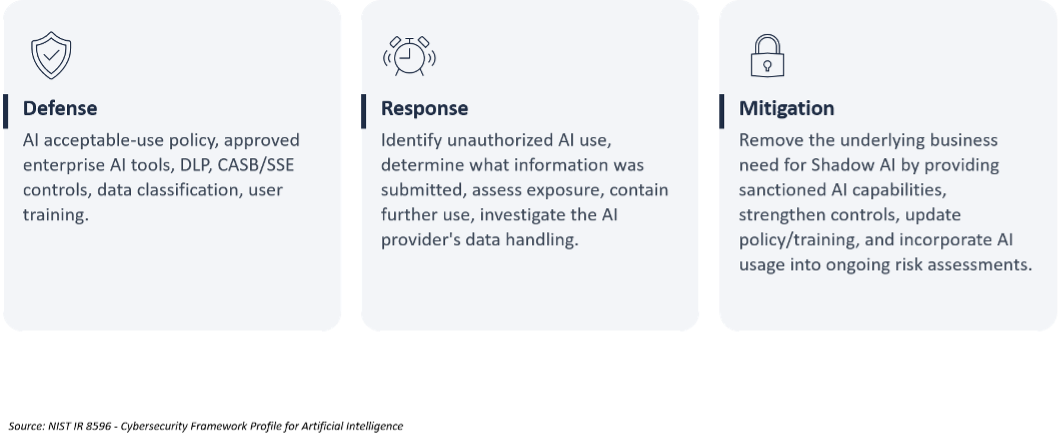
Effective Shadow AI management combines proactive security controls, incident response and continuous improvement. Organizations should extend existing safeguards to AI tools and data, monitor for unauthorized use, and establish procedures to identify and contain incidents, assess data exposure and address underlying vulnerabilities. Ongoing reviews and updated governance help reduce risk while enabling secure AI adoption.
Privacy Risks
Using AI tools carries several data and privacy risks that organizations need to manage carefully. Entering sensitive or confidential information into an AI tool can expose it to unauthorized access or unintended use, so users should be mindful of what they share. Because AI platforms may store or process data in other jurisdictions, their use can also trigger additional legal and regulatory obligations. Finally, third-party vendors often provide limited visibility into how data is retained or deleted, which makes thorough due diligence and clear contractual terms essential.
Applying Core Privacy Principles
Established privacy principles apply to AI just as they do elsewhere:
• Data minimization: Share only what is needed for the task. Where possible, remove, anonymize, or substitute test data for personal information.
• Purpose limitation: Data collected for one purpose should not automatically be repurposed for AI. Confirm the new use fits the original purpose and that you have the authority to use it.
• Transparency: People should know when and how AI is used, especially when it involves their information or affects decisions about them.
• Consent: Uploading someone’s personal or sensitive information into an AI tool may require their consent.
Legal and Compliance Risks
AI use must comply with all applicable legislation, including privacy. Using information for purposes not contemplated at collection, or without proper consent or legal authority, creates compliance exposure. AI involving personal information may also draw scrutiny from privacy commissioners and regulators, so organizations must be able to show that governance, safeguards, and oversight are in place.
Ethical Risks
An AI system can reflect bias in its training data, algorithms, or outputs, leading to unfair or discriminatory outcomes, and Shadow AI makes this harder to catch because the tools have not been vetted. Employees may also place too much trust in AI outputs that sound confident or authoritative accepting them without sufficient human review. The principle here is simple; AI should support human decision-making, not replace responsibility. The “AI said so” is never an acceptable rationale, and organizations need clear ownership for reviewing, validating, and acting on AI outputs.
Operational Risks
AI can produce information that is incorrect, incomplete, or misleading, and in the case of Shadow AI, those outputs may be used without validation. Unsanctioned tools also leave organizations unaware of what tool was used, what data went in, and how an output was produced, making it hard to investigate incidents, reproduce decisions, or demonstrate compliance. On top of that, when different employees use different tools, models, and prompts for similar tasks, the result is inconsistent outputs and decisions, particularly where AI supports professional judgment.
Trust and Reputation
Biased or unethical AI use can erode client trust and damage an organization’s reputation. It is becoming increasingly clear that ethical AI use is a competitive advantage.
Preventing and Managing Shadow AI
We know that shadow AI is not an AI problem, it is a governance problem. Addressing Shadow AI starts with recognizing what it really is; a governance gap, not a technology failure. The solution lies in clear policies and defined accountability.
Policy and Governance
Organizations need practical, easy-to-understand guidelines for responsible AI use. These should spell out which AI tools are approved, what the acceptable use cases are, and which data inputs are off-limits, such as personal, health, confidential, or otherwise sensitive information. The good news is that organizations do not have to start from scratch. Existing policies and processes for privacy, security, records management, procurement, and risk management provide a solid foundation to build on.
Responsibility for AI-assisted decisions and outputs must be clearly defined and documented. AI should support human decision-making, not replace accountability, which means AI-generated content and recommendations need appropriate human review before anyone acts on them. Consider AI scribes in healthcare, for example. Providers should review and sign off on AI-generated clinical notes before they are added to a patient’s record, because the provider, not the AI, remains accountable for the accuracy and appropriateness of that record.
Enablement
Governance only works if employees have a realistic way to follow it. The most effective defense against Shadow AI is giving people secure, approved tools and making responsible use part of how work already gets done.
AI should not be treated as a separate or informal activity. It works best when built into established processes, systems, and governance structures. Start by identifying low-risk use cases where AI can improve efficiency, reduce administrative burden, and support employees. Privacy, security, and human-review requirements should be designed into the workflow from the start, not bolted on later. Practical guidance, training, and real examples help employees understand how to use AI safely within their existing roles.
Shadow AI usually emerges when there is a gap between what employees need to accomplish and what the organization allows. When approved tools are hard to access, overly restrictive, or simply unavailable, people will find their own workarounds. The answer is a safe, supported path to adoption: available tools, clear rules, and timely support. Organizations should encourage employees to ask questions, report their AI use, and seek approval rather than hide what they are doing.
Training and Awareness
AI literacy is a core control for managing Shadow AI, as employees need to know not only how to use AI but when not to. Organizations should provide foundational training for all staff covering how AI works and its limitations, why sensitive or confidential information should not go into unapproved tools, safe prompting practices, how to identify sensitive data, the need to review AI outputs for accuracy, and how to recognize Shadow AI use.
This should be complemented by role-specific training tailored to different workflows and risk levels, such as AI scribes for healthcare providers, candidate data for HR, and AI-generated content for communications teams. Using real-world scenarios, training should reinforce when to use AI, what can be shared, which tools are approved, and when human review is required.
Culture and Leadership
Leadership support is essential to responsible AI adoption. Leaders should position AI as a strategic tool that must be used responsibly and ethically and model this by following the same policies expected of employees.
Organizations should foster a culture of responsible experimentation by encouraging employees to explore useful AI applications within risk-based guardrails. Employees should feel safe disclosing their AI use and asking whether AI is appropriate for a task, with questions and mistakes treated as opportunities to improve guidance and governance. The goal is to celebrate responsible innovation, not just AI adoption.
Key Takeaways
• Shadow AI is inevitable, but unmanaged risk is not
• Focus on enablement and governance, not just restriction
• Data is the core risk – protect it
• Privacy and ethics must be embedded from the start